Ultraswage – Precision Engineered Solutions for Critical Industrial Applications. Built for Performance. Tested for Reliability. Quality Assured • Industry Approved • Customer Trusted.
Correct polymer selection is a combined decision involving fluid chemistry, continuous and peak temperature, pressure, static/dynamic duty, extrusion gap, decompression, cleanliness, regulatory requirements and expected service life.
FFKM
Perfluoroelastomer
When chemical attack and temperature leave almost no room for compromise.
≈ -25 to +325°C
Practical family-level screening window · specialty FFKM grades can reach approximately -46°C at the low end or up to +350°C at the high end, but not in one universal compound
Semiconductor
Chemical Processing
Oil & Gas
Refining
Pharma
Aerospace
Nuclear
ULTIMATE CHEMISTRY
WHY USE IT
FFKM is a fully fluorinated elastomer family designed for the most aggressive combinations of chemistry and temperature. Its carbon–fluorine-rich backbone gives chemical resistance approaching PTFE while retaining elastomeric recovery. It is selected for semiconductor process chemistry, chemical plants, refineries, sour-service equipment and high-purity systems where conventional FKM, EPDM or FEPM may reach a chemical or thermal limit. The critical point: FFKM is a family, not one universal compound—low-temperature, amine/steam, ultra-high-temperature, high-purity and rapid-decompression grades are formulated differently.
TOP 5 COMPATIBLE MEDIA — SCREENING GUIDE
✓ Sulfuric & nitric acids
✓ Strong caustics / NaOH
✓ Ketones such as acetone / MEK
✓ Aromatic & chlorinated hydrocarbons
✓ Aggressive process solvents
WATCH-OUTS / NOT FIRST CHOICE
! Grade-specific steam limits
! Some low-temperature applications
! Highly fluorinated media require grade check
! Dynamic wear requires engineering review
! Cost-sensitive general service]\
TYPICAL PRODUCTS AVAILABLE IN THIS POLYMER FAMILY
Precision O-Rings
AS568 / Metric O-Rings
Custom large O-Rings
Valve & pump seals
Mechanical-seal secondary seals
Semiconductor chamber seals
High-purity gaskets
Custom moulded critical seals
FKM
Fluoroelastomer / Fluorocarbon
The high-value workhorse for heat, fuels, oils and aggressive industrial service.
-20 to +200°C
Practical family-level screening window · specialty FFKM grades can reach approximately -46°C at the low end or up to +350°C at the high end, but not in one universal compound
Oil & Gas
Automotive
Aerospace
Pumps & Valves
Refineries
Chemical Equipment
HIGH PERFORMANCE
WHY USE IT
FKM is a primary choice where mineral oils, fuels, aromatic hydrocarbons and elevated temperature occur together. Different fluorine content and cure systems can significantly change chemical resistance, compression set and low-temperature performance.
TOP 5 COMPATIBLE MEDIA — SCREENING GUIDE
✓ Petrol / gasoline
✓ Diesel & fuel oils
✓ Mineral & synthetic lubricants
✓ Toluene / aromatic hydrocarbons
✓ Many dilute mineral acids
WATCH-OUTS / NOT FIRST CHOICE
! Hot amines
! Strong caustics
! Ketones such as acetone
! Hot water / steam unless special grade
! Very low temperature unless LT grade
TYPICAL PRODUCTS AVAILABLE IN THIS POLYMER FAMILY
O-Rings
X-Rings / Quad seals
Valve stem seals
Fuel-system seals
Gaskets
V-Seals
Rubber-to-metal bonded seals
Custom moulded diaphragms
Hammer-union / pressure seals
FEPM
TFE-Propylene / Aflas®-type
The specialist answer for steam, hot amines, caustics and sour service.
-9 to +232°C
Oil & Gas
Geothermal
Chemical Plants
Pulp & Paper
Steam Systems
Refining
HIGH PERFORMANCE
WHY USE IT
FEPM fills a unique gap between EPDM, FKM and FFKM. It performs strongly in high-temperature steam, bases, amines and sour-gas environments where standard FKM can be vulnerable.
TOP 5 COMPATIBLE MEDIA — SCREENING GUIDE
✓ Steam & hot water
✓ Sodium hydroxide / caustic
✓ Amines
✓ Hydrogen sulfide / sour gas
✓ Phosphate-ester fluids
WATCH-OUTS / NOT FIRST CHOICE
! Low-temperature flexibility is limited
! Aromatic fuels need grade review
! Some ketones / solvents are grade dependent
! Compression set can be higher than premium FKM
! Not a universal FFKM substitute
TYPICAL PRODUCTS AVAILABLE IN THIS POLYMER FAMILY
O-Rings
High-pressure seals
Steam-service gaskets
Valve seals
Pump seals
Hammer-union seals
Wellhead / sour-gas seals
Custom moulded parts
FVMQ
Fluorosilicone
Silicone-like cold flexibility with far better fuel and hydrocarbon resistance.
≈ -70 to +180°C
Typical FVMQ O-ring family range · Parker reference ≈ -73 to +177°C · specialty compounds vary
Aerospace
Defence
Fuel Systems
CNG / Gas
Automotive
Low-temperature equipment
LOW TEMP + FUEL
WHY USE IT
FVMQ is used where very low-temperature flexibility is needed together with fuel, oil or hydrocarbon exposure. It is particularly attractive in aerospace, fuel systems and precision static seals.
TOP 5 COMPATIBLE MEDIA — SCREENING GUIDE
✓ Aviation turbine fuels
✓ Petrol / gasoline
✓ Aromatic mineral oils
✓ Aliphatic hydrocarbons
✓ Selected synthetic lubricants
WATCH-OUTS / NOT FIRST CHOICE
! Ketones
! Strong bases
! Steam service
! High-abrasion dynamic use
! Concentrated acids require grade check
TYPICAL PRODUCTS AVAILABLE IN THIS POLYMER FAMILY
O-Rings
Fuel connector seals
Injector seals
Membranes
Diaphragms
Gaskets
Sensor seals
Precision moulded aerospace seals
HNBR
Hydrogenated Nitrile
High mechanical strength, oil resistance and better heat/ozone performance than NBR.
-30 to +150°C
Oil & Gas
Hydraulics
Automotive
Refrigeration
Industrial Pumps
High-pressure equipment
TOUGH OIL SERVICE
WHY USE IT
HNBR is chosen when NBR’s oil resistance is desirable but higher temperature, ozone, abrasion, mechanical strength or demanding oil-and-gas duty is required. Special grades can be engineered for rapid gas decompression resistance.
TOP 5 COMPATIBLE MEDIA — SCREENING GUIDE
✓ Mineral oils
✓ Hydraulic oils
✓ Diesel / fuel oils
✓ Water-glycol fluids
✓ Selected refrigerants
WATCH-OUTS / NOT FIRST CHOICE
! Ketones
! Esters in many grades
! Strong aromatic solvents
! Strong oxidising acids
! Steam at extreme temperature
TYPICAL PRODUCTS AVAILABLE IN THIS POLYMER FAMILY
O-Rings
AED/RGD O-Rings
Hammer-union seals
Lip seals
Static seals
Flat belts
Bonded plug seals
Gaskets
High-pressure custom seals
VMQ
Silicone Rubber
Exceptional temperature flexibility, cleanliness and food/medical potential.
≈ -55 to +200°C
Typical VMQ O-ring family range · special silicone compounds can extend toward ≈ -115°C low-temperature or ≈ +260°C high-temperature capability
Food & Beverage
Medical
Electrical
Aerospace
Ovens
Pharma
Appliances
EXTREME TEMPERATURE SPAN
WHY USE IT
Silicone remains flexible at temperatures where many organic elastomers stiffen, while also tolerating elevated dry heat. Properly formulated grades can support food, medical, electrical and clean applications.
TOP 5 COMPATIBLE MEDIA — SCREENING GUIDE
✓ Hot air / oxygen
✓ Water up to moderate temperature
✓ Glycerin
✓ Selected food fats & oils
✓ Selected high-MW chlorinated media
WATCH-OUTS / NOT FIRST CHOICE
! Petroleum fuels
! Aromatic solvents
! Ketones
! Strong concentrated acids/alkalis
! High abrasion / tear service
TYPICAL PRODUCTS AVAILABLE IN THIS POLYMER FAMILY
Food-grade O-Rings
Medical O-Rings
Gaskets
Bellows
Diaphragms
Grommets
Washers
Dust covers
Custom moulded components
Silicone bonded parts
EPDM
Ethylene Propylene Diene Rubber
The first material to consider for hot water, steam, glycol and outdoor exposure.
-45 to +150°C
Water Treatment
Food & Beverage
Pharma
HVAC
Brake Systems
Outdoor Equipment
WATER + STEAM
WHY USE IT
EPDM is highly resistant to water, weathering, ozone and many polar fluids. Peroxide-cured grades are widely used for hot water, steam and hygienic systems, but EPDM should not be used with petroleum oils or hydrocarbon fuels.
TOP 5 COMPATIBLE MEDIA — SCREENING GUIDE
✓ Hot water & steam
✓ Glycol brake fluids
✓ Phosphate-ester hydraulic fluids
✓ Dilute acids
✓ Dilute alkalis / cleaning agents
WATCH-OUTS / NOT FIRST CHOICE
! Mineral oils
! Petrol / diesel
! Aromatic hydrocarbons
! Most hydrocarbon solvents
! Petroleum greases
TYPICAL PRODUCTS AVAILABLE IN THIS POLYMER FAMILY
O-Rings
Sanitary gaskets
Water-system seals
Diaphragms
Washers
Grommets
Expansion seals
Valve seats
Custom moulded parts
NBR
Nitrile / Buna-N
The industry standard for economical oil-resistant sealing.
-30 to +100°C
Hydraulics
Pneumatics
General Industry
Machine Tools
Automotive
Pumps
GENERAL OIL SERVICE
WHY USE IT
NBR provides an excellent balance of cost, strength, abrasion resistance and petroleum-oil compatibility. Acrylonitrile content can be adjusted to trade low-temperature flexibility against fuel/oil resistance.
TOP 5 COMPATIBLE MEDIA — SCREENING GUIDE
✓ Mineral hydraulic oils
✓ Engine & gear oils
✓ Greases
✓ Diesel / fuel oil
✓ Aliphatic hydrocarbons
WATCH-OUTS / NOT FIRST CHOICE
! Ozone / outdoor exposure
! Ketones
! Esters
! Strong polar solvents
! High-temperature air service
TYPICAL PRODUCTS AVAILABLE IN THIS POLYMER FAMILY
O-Rings
Oil seals
V-Seals
Gaskets
Grommets
Washers
Diaphragms
Bellows
Dust seals
Rubber-to-metal bonded parts
Custom moulded seals
CR
Chloroprene / Neoprene-type
A balanced all-round elastomer for weather, water, moderate oil and mechanical duty.
-35 to +100°C
Marine
HVAC / Refrigeration
Outdoor Equipment
General Industry
Bonded Components
BALANCED MULTI-PURPOSE
WHY USE IT
CR combines useful oil resistance with better ozone and weather performance than NBR. It is a practical material for outdoor industrial components, refrigerant-related service and general-purpose rubber-to-metal applications.
TOP 5 COMPATIBLE MEDIA — SCREENING GUIDE
✓ Water & seawater
✓ Mineral oils at moderate temperature
✓ Greases
✓ Dilute acids
✓ Dilute alkalis
WATCH-OUTS / NOT FIRST CHOICE
! Aromatic hydrocarbons
! Ketones
! Esters
! Strong oxidising acids
! Halogenated solvents
TYPICAL PRODUCTS AVAILABLE IN THIS POLYMER FAMILY
O-Rings
Gaskets
Grommets
Washers
Bellows
Mounts
Rubber-to-metal bonded parts
Dust boots
Custom moulded components
AEM
Ethylene Acrylic Elastomer
A strong middle ground between HNBR and FKM for hot automotive lubricants.
-40 to +160°C
Automotive
Transmission Systems
Powertrain
Gearboxes
Industrial Drives
HOT AUTOMOTIVE OIL
WHY USE IT
AEM offers strong heat, ozone and oil resistance with better low-temperature behavior than ACM. It is widely associated with modern powertrain, gearbox and under-hood sealing.
TOP 5 COMPATIBLE MEDIA — SCREENING GUIDE
✓ Engine oils
✓ Gear oils
✓ Automatic transmission fluids
✓ Greases
✓ Special AdBlue-compatible formulations
WATCH-OUTS / NOT FIRST CHOICE
! Strong acids
! Strong bases
! Aromatic fuels
! Ketones
! Highly aggressive solvents
TYPICAL PRODUCTS AVAILABLE IN THIS POLYMER FAMILY
O-Rings
Oil-pan gaskets
Cam-cover seals
Gearbox seals
Grommets
Custom moulded gaskets
Connector seals
ACM
Polyacrylate Rubber
Designed for hot lubricating oils when low-temperature flexibility is secondary.
-20 to +150°C
Automotive
Transmission
Engines
Gearboxes
Hot Lubrication Systems
HOT OIL
WHY USE IT
ACM is valued for resistance to hot mineral oils, oxidation and ozone, particularly in automotive powertrain systems. Its main trade-off is limited low-temperature flexibility and poorer water resistance.
TOP 5 COMPATIBLE MEDIA — SCREENING GUIDE
✓ Hot engine oils
✓ ATF
✓ Gear oils
✓ Additive-rich lubricants
✓ Greases
WATCH-OUTS / NOT FIRST CHOICE
! Water / steam
! Brake fluids
! Ketones
! Aromatic fuels
! Low-temperature applications
TYPICAL PRODUCTS AVAILABLE IN THIS POLYMER FAMILY
O-Rings
Oil seals
Transmission seals
Gaskets
Shaft-seal elements
Custom hot-oil mouldings
ECO
Epichlorohydrin Rubber
Useful where fuel resistance, ozone resistance and lower gas permeability are combined.
-40 to +135°C
Automotive
Fuel Systems
Refrigeration
Hose & Connector Systems
FUEL + LOW PERMEATION
WHY USE IT
ECO is a specialty elastomer offering a useful balance of fuel/oil resistance, ozone ageing and low gas permeability. It has historically been used in fuel, hose and automotive sealing applications.
TOP 5 COMPATIBLE MEDIA — SCREENING GUIDE
✓ Petroleum fuels
✓ Mineral oils
✓ Aliphatic hydrocarbons
✓ Selected refrigerants
✓ Ozone / atmospheric exposure
WATCH-OUTS / NOT FIRST CHOICE
! Strong acids
! Strong bases
! Ketones
! Esters
! Aggressive polar solvents
TYPICAL PRODUCTS AVAILABLE IN THIS POLYMER FAMILY
O-Rings
Fuel seals
Gaskets
Diaphragms
Grommets
Connector seals
Custom moulded components
IIR
Butyl Rubber
Excellent gas retention and polar-fluid resistance for selected static sealing duties.
-50 to +120°C
Vacuum / Gas Retention
Chemical Service
Brake Systems
Water Systems
Damping
LOW GAS PERMEATION
WHY USE IT
Butyl rubber is notable for very low gas permeability and strong resistance to weathering, ozone, water and many polar chemicals. It is poor with petroleum oils and fuels.
TOP 5 COMPATIBLE MEDIA — SCREENING GUIDE
✓ Phosphate-ester fluids
✓ Glycol brake fluids
✓ Dilute acids
✓ Dilute alkalis
✓ Steam / hot water within grade limits
WATCH-OUTS / NOT FIRST CHOICE
! Mineral oils
! Hydrocarbon fuels
! Aromatic solvents
! Petroleum greases
! Many aliphatic hydrocarbons
TYPICAL PRODUCTS AVAILABLE IN THIS POLYMER FAMILY
O-Rings
Gaskets
Diaphragms
Vacuum seals
Gas-retention seals
Stoppers
Custom moulded parts
AU / EU
Polyurethane Elastomer
The mechanical-performance specialist for wear, pressure and dynamic sealing.
-40 to +100°C
Hydraulics
Pneumatics
Mining
Mobile Equipment
High-pressure Machinery
ABRASION + EXTRUSION
WHY USE IT
Polyurethane is selected when tensile strength, abrasion resistance, extrusion resistance and load-bearing capability are more important than broad chemical resistance or extreme temperature.
TOP 5 COMPATIBLE MEDIA — SCREENING GUIDE
✓ Mineral hydraulic oils
✓ Lubricating oils
✓ Greases
✓ Aliphatic hydrocarbons
✓ Selected water-glycol fluids
WATCH-OUTS / NOT FIRST CHOICE
! High-temperature continuous service
! Strong acids
! Strong alkalis
! Ketones
! Hydrolysis-sensitive service without correct PU type
TYPICAL PRODUCTS AVAILABLE IN THIS POLYMER FAMILY
O-Rings
U-Cups
Rod seals
Piston seals
Scrapers
Wipers
Buffers
High-pressure backup seals
Wear-resistant custom parts
NR
Natural Rubber
Exceptional resilience, tear strength and elasticity for mechanical rather than oil service.
-50 to +80°C
Anti-vibration
Mechanical Components
Water Service
Industrial Equipment
Wear Components
HIGH ELASTICITY
WHY USE IT
Natural rubber remains one of the best materials for resilience, dynamic fatigue and tear strength. It is selected for mechanical components, vibration control and water-based service, not petroleum-oil or ozone-intensive applications.
TOP 5 COMPATIBLE MEDIA — SCREENING GUIDE
✓ Water
✓ Dilute acids
✓ Dilute alkalis
✓ Alcohols
✓ Glycol solutions
WATCH-OUTS / NOT FIRST CHOICE
! Mineral oils
! Petroleum fuels
! Ozone
! Weathering without protection
! Hydrocarbon solvents
TYPICAL PRODUCTS AVAILABLE IN THIS POLYMER FAMILY
O-Rings for compatible media
Gaskets
Buffers
Mounts
Bushes
Bellows
Diaphragms
Rubber-to-metal bonded parts
Custom mouldings
SBR
Styrene Butadiene Rubber
Economical general-purpose rubber for water, brake-fluid and mechanical applications.
-40 to +100°C
General Industry
Water Systems
Mechanical Components
Brake-fluid Service
GENERAL MECHANICAL
WHY USE IT
SBR is an economical general-purpose elastomer with good abrasion behavior and useful performance in water-based systems. It is not intended for petroleum fuels, oils or severe ozone exposure.
TOP 5 COMPATIBLE MEDIA — SCREENING GUIDE
✓ Water
✓ Glycol brake fluids
✓ Dilute acids
✓ Dilute alkalis
✓ Alcohols
WATCH-OUTS / NOT FIRST CHOICE
! Mineral oils
! Petrol / diesel
! Aromatic hydrocarbons
! Ozone / weathering
! Strong solvents
TYPICAL PRODUCTS AVAILABLE IN THIS POLYMER FAMILY
O-Rings for compatible service
Gaskets
Washers
Grommets
Pads
Diaphragms
Custom moulded parts
Chemical compatibility note: representative screening examples only—not a warranty of suitability. Concentration, temperature, pressure, exposure time, additives, cure system and exact formulation can change compatibility. Final selection should be confirmed against the specific compound datasheet and, where critical, application testing.
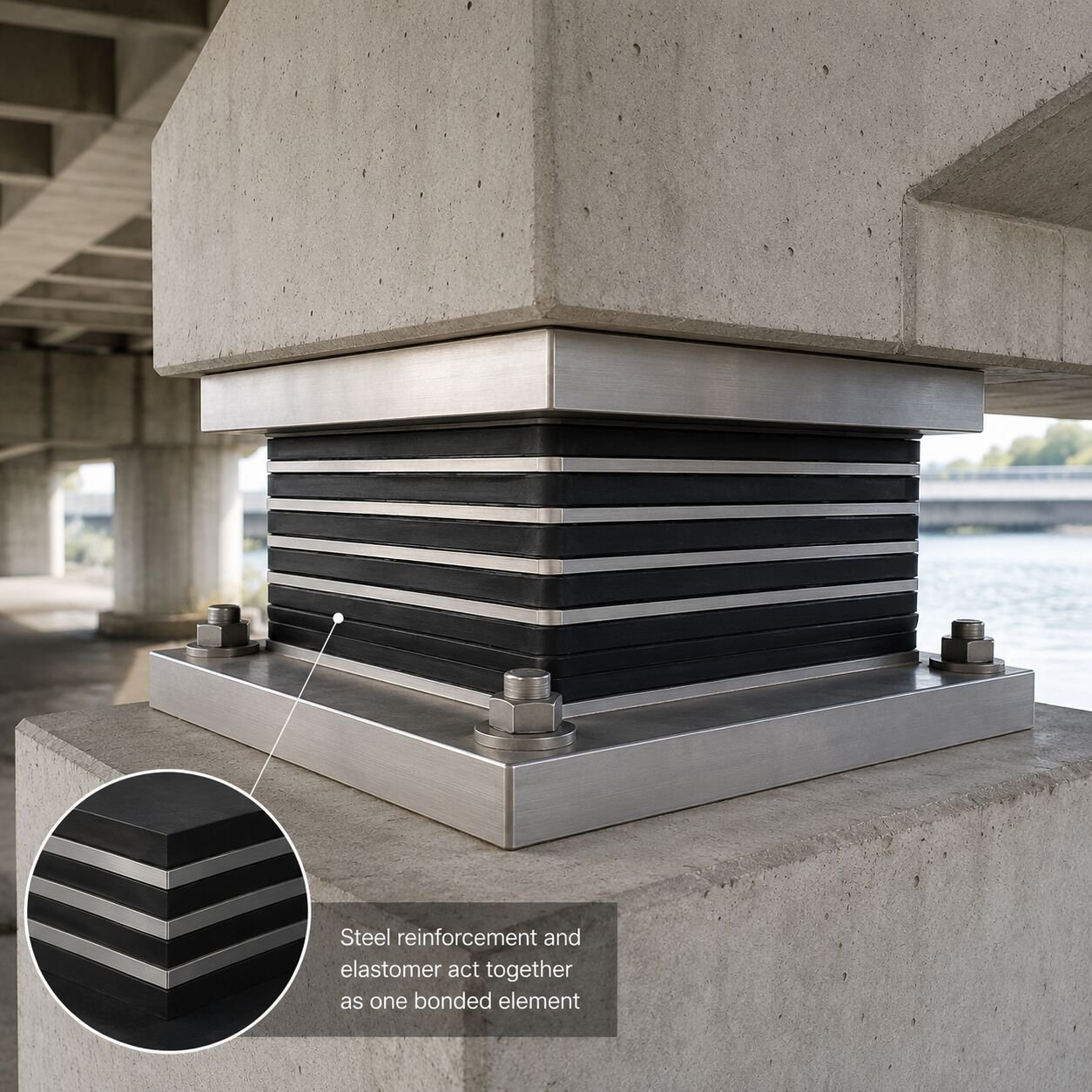
ELASTOMERIC BEARING CONSTRUCTION
Steel reinforcement and elastomer act together as one bonded element
In a laminated elastomeric bearing, the elastomer provides flexibility while the internal steel plates restrain bulging under compression. Because the reinforcement is fully embedded and bonded during vulcanisation, the bearing behaves as a composite element rather than a stack of loose plates.
Cover Elastomer
Protects embedded reinforcement and forms the external bearing surface.
Elastomer Layers
Provide controlled shear flexibility and rotational compliance.
Internal Steel Laminates
Restrict lateral expansion and increase compressive stiffness.
Bonded Interfaces
Rubber-to-metal adhesion is established during the controlled manufacturing process.
BEARING FUNCTION
Fixed, guided or free: the bearing arrangement controls the movement path
Modern structural-bearing systems are commonly arranged according to how they allow or restrain horizontal movement. The correct combination across the structure directs thermal movement and horizontal forces to the intended support locations.
Component
Typical Material / System
Engineering Function
Elastomer
Natural rubber (NR) or chloroprene rubber (CR), as specified
Provides resilience, shear flexibility, rotation capability and environmental resistance appropriate to the application.
Internal reinforcement
Steel laminates / reinforcement plates
Restrains lateral expansion of elastomer under compression and increases vertical stiffness.
Structural steel parts
Machined or fabricated steel components to project specification
Transfers load through pots, pistons, base plates, top plates, guide bars, anchor plates and connection hardware.
Sliding material
PTFE or other approved structural sliding material
Provides a low-friction sliding interface for controlled translational movement.
Mating surface
Suitable stainless-steel sliding surface or approved mating material
Provides the smooth counterface required by the sliding element.
Bonding system
Controlled rubber-to-metal primer / adhesive system
Creates durable adhesion between elastomer and metallic reinforcement/components.
Corrosion protection
Coating / plating / paint system according to environment and specification
Protects exposed steel surfaces through storage, installation and service.
ENGINEERING PHILOSOPHY
From compound preparation to final inspection, every stage affects bearing performance.
Structural bearings operate under sustained compression while repeatedly accommodating movement and rotation. Consistency of compound properties, reinforcement preparation, bond integrity, moulding, machining, assembly and final inspection therefore matters as much as the nominal external dimensions.
Material Control
Traceable elastomer, steel, sliding and bonding materials
Bond Integrity
Controlled steel preparation and rubber-to-metal bonding process
Dimensional Control
Layer build-up, geometry and interfaces checked against approved drawings
Documented QA
Inspection and test documentation linked to production identification
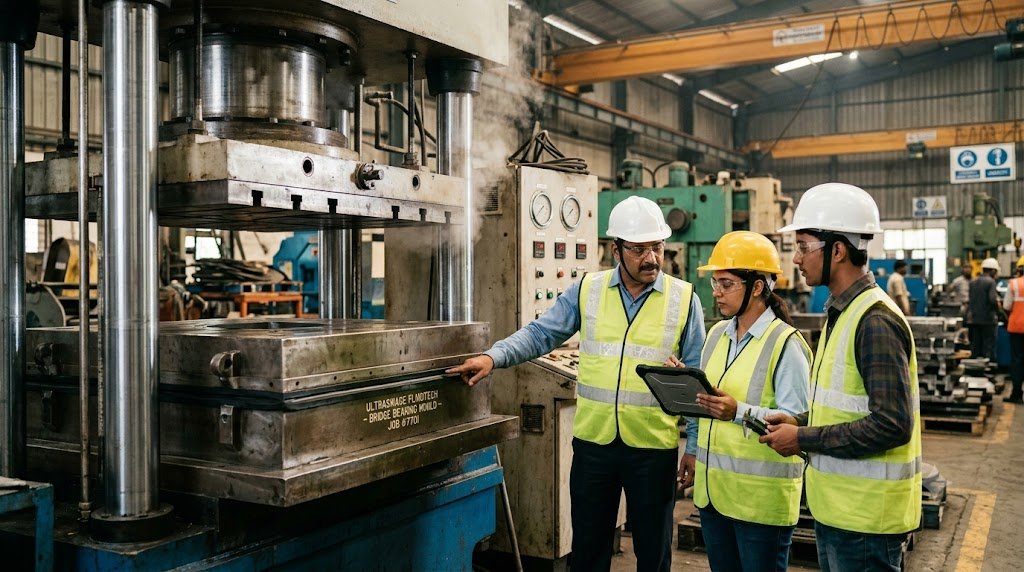
A controlled process from raw materials to dispatch
The website should show Ultraswage’s actual manufacturing photographs in this section. The flow below is the intended technical story; the developer should replace generic illustrations with factory images as each operation is confirmed.
01 · COMPOUND
Elastomer Preparation
Controlled formulation, mixing, batch identification and process-property checks for the specified bearing compound.
02 · STEEL
Reinforcement Preparation
Cutting/machining, deburring, cleaning and surface preparation of internal laminates and structural components.
03 · BOND
Bonding Preparation
Controlled surface condition and application of compatible bonding systems before mould lay-up.
04 · MOULD
Lay-up & Vulcanisation
Accurate layer positioning followed by controlled moulding pressure, temperature and cure cycle.
05 · MACHINE
Steel Component Machining
Precision machining and fabrication of POT, spherical, guide, base, top and anchorage components where applicable.
06 · ASSEMBLE
Bearing Assembly
Assembly of elastomeric, sliding and steel components with orientation and fit-up checks.
07 · INSPECT
Final Inspection & Testing
Visual, dimensional, material and complete-bearing checks as required by the approved QAP and governing specification.
08 · TRACE
Marking & Dispatch
Bearing identification, movement/orientation marks, test documentation, protection and project-wise packing.
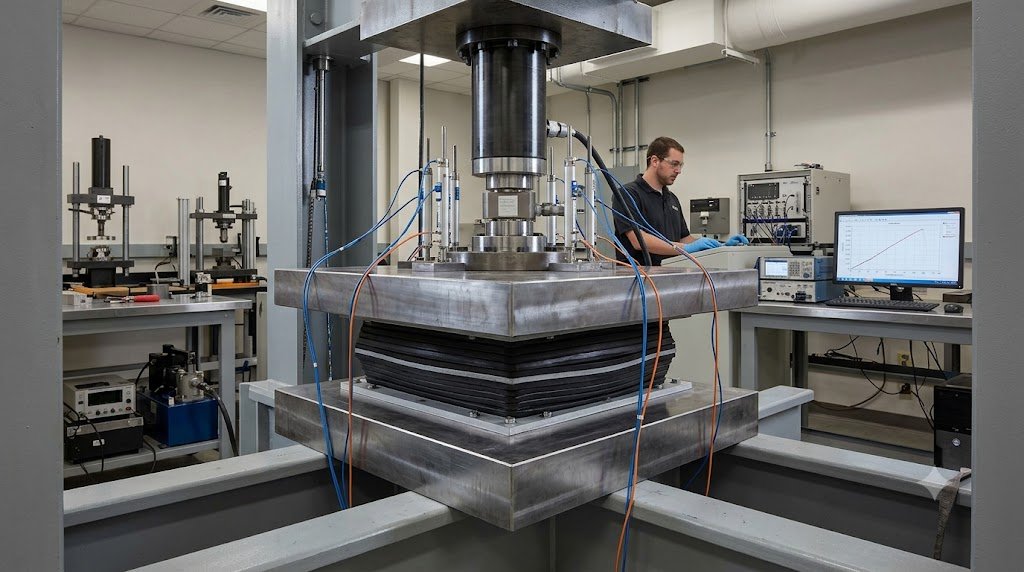
Verification at material, component and complete-bearing level
Inspection requirements vary by bearing type and project. Ultraswage’s quality plan should define the applicable tests, sampling, witness points, acceptance criteria and documentation before production.
Visual & Dimensional Inspection
External dimensions, layer geometry, workmanship, steel components and bearing identification.
Elastomer Properties
Hardness/IRHD, tensile properties, elongation, ageing and other specified compound tests.
Shear Behaviour
Shear modulus or related elastomeric-bearing verification as required by the applicable standard.
Compression Behaviour
Compression stiffness or load response tests where specified.
Bond / Adhesion
Verification of rubber-to-metal bond integrity and reinforcement preparation controls.
Sliding / Movement
Sliding-interface and movement-related checks for PTFE, POT and spherical bearing assemblies as applicable.
Load / Proof Testing
Complete-bearing load testing when required by the specification, QAP or inspection authority.
Material Traceability
Linkage of elastomer batches, steel records, sliding materials and inspection reports to bearing marks.
STANDARDS & SPECIFICATIONS
Designed and manufactured against the applicable project requirements
Bridge bearings are project-engineered products. The governing code, authority specification, approved drawing and inspection plan define the final design, materials, tests, tolerances and documentation. Applicable references may include:
INDIA · ROAD
IRC:83 Series
Applicable parts of IRC:83 for elastomeric, POT/plane-sliding and spherical/cylindrical bridge bearing systems, together with current amendments and project requirements.
INDIA · RAIL
RDSO / Indian Railways
Applicable current RDSO specifications, STRs, approved drawings and Railway project requirements for bridge-bearing applications.
INDIA · WORKS
MoRTH Specifications
Applicable requirements of the current project edition of the Ministry of Road Transport & Highways specifications and contract documents.
INTERNATIONAL
EN 1337
European structural-bearing standard series for project applications where EN requirements are specified.
INTERNATIONAL
AASHTO / ASTM
Applicable AASHTO and ASTM requirements for projects designed and procured to North American specifications.
PROJECT SPECIFIC
Consultant / Client Specifications
Client drawings, technical specifications, inspection plans and approved deviations take precedence where project requirements are more specific.
Compliance and approval statements must only be published for standards, product ranges and authority approvals actually held or verified by Ultraswage at the time of supply.
Applications
Structural support systems for transport and infrastructure projects
Made around the structure — not the other way around
Bearings can be configured around the project’s required load path, permitted movement, rotation, support geometry, installation space and connection details. Depending on the bearing type, project-specific features may include anchor plates, sole plates, guide bars, restraint elements, sliding plates, movement indicators, temporary transport restraints and orientation markings.
Final manufacturing is released against approved drawings and the agreed inspection and test plan, enabling each bearing position to be identified and matched to the bridge bearing schedule.
TRACEABILITY & DOCUMENTATION
Engineering documentation that follows the bearing
Infrastructure customers, consultants and inspection agencies require more than a finished component. The supply package can be structured to provide traceability from approved drawing and incoming materials through manufacture, testing, final inspection and dispatch.
Approved Drawings
Bearing geometry, interfaces, orientation and marking details.
Quality Plan / ITP
Inspection stages, test requirements, hold/witness points and acceptance criteria.
Material Records
Applicable elastomer, steel, sliding material and coating/bonding traceability.
Test Certificates
Material and/or complete-bearing test reports as required by the project.
Inspection Release
Final dimensional/visual inspection and third-party/client release where applicable.
Bearing Identification
Bearing mark, location, orientation and production traceability.
Packing Records
Project- and bearing-position-wise dispatch identification.
Installation Information
Storage, handling, setting/orientation and installation notes where required.
INSTALLATION & SERVICE
Correct installation preserves the movement the bearing was designed to provide
Even a correctly manufactured bearing can perform poorly if it is installed on an unsuitable seating surface, misoriented, contaminated, damaged or restrained unintentionally. Installation therefore forms part of the complete bearing system.
Storage & Handling
Keep bearings protected from damage, contamination and inappropriate storage conditions. Do not lift or handle assemblies in a manner that damages sliding surfaces, elastomer or protective coatings.
Setting & Orientation
Confirm bearing mark, movement direction, approved drawing, support position, mating surfaces and any specified preset or installation-temperature requirement before placement.
Seating Surfaces
Support and mating surfaces must satisfy project requirements for level, alignment, contact and grout or pedestal preparation.
Post-Installation Check
Verify final position, alignment, movement clearances, restraints, anchorage and removal of temporary transport devices where applicable.
Periodic Inspection
Service inspections may check displacement, shear position, elastomer condition, delamination, corrosion, contamination, sliding clearances and signs of abnormal movement.
Replacement Planning
Where existing bearings require replacement, the bearing geometry, support condition, jacking arrangement and sequence must be engineered as part of the rehabilitation methodology.
TECHNICAL FAQ
Bridge bearing fundamentals
Why are steel plates used inside laminated elastomeric bearings?
Internal steel laminates restrain lateral expansion of the elastomer when the bearing is compressed. This substantially increases vertical stiffness while allowing the elastomer layers to deform in shear and accommodate rotation.
What is the difference between elastomeric and sliding elastomeric bearings?
A standard laminated elastomeric bearing accommodates horizontal movement mainly by shear deformation of the elastomer. A sliding elastomeric bearing adds a low-friction sliding interface so larger translational movement can be accommodated without relying only on elastomer shear.
What is the difference between fixed, guided and free bearings?
A fixed bearing restrains horizontal movement in both principal directions. A guided bearing permits movement along one direction and transfers horizontal force in the perpendicular direction. A free-sliding bearing permits movement in both plan directions while transmitting the required vertical load and accommodating rotation.
Why are POT bearings used?
POT bearings use a confined elastomeric pad to accommodate rotation under high vertical compression. With appropriate sliding and guide components, they can also provide free or guided horizontal movement in a compact bearing assembly.
When are spherical bearings considered?
Spherical bearings are used when the structural solution requires high load capacity and significant rotational capability, often together with guided or free sliding movement. The final selection depends on the project's load, movement, rotation, geometry and applicable standard.
Are bridge bearings maintenance-free?
Bridge bearings should not be described generically as maintenance-free. Inspection requirements depend on bearing type and project. Elastomer condition, movement position, steelwork, sliding surfaces, clearances, corrosion and surrounding structural conditions may all require periodic review.
Engineered structural support solutions from Ultraswage.
For bridge bearings, replacement bearings, project-specific drawings and technical requirements, contact the Ultraswage team with the project specification or bearing schedule.