

Link1
Link2
Link3

Precision sealing begins with material intelligence.
Critical sealing starts with the right polymer, then goes deeper: cure chemistry, compression behaviour, chemical exposure, pressure, motion, surface condition and long-term recovery.
Ultraswage brings together advanced elastomer selection, precision O-ring engineering and inspection-ready supply for demanding applications—from NBR and HNBR to FKM, FEPM, FVMQ and ultra-high-performance FFKM.
Explore Materials
O-Ring Engineerings
FFKM → NR
AS568 + Metric
60–90 Shore A
Custom Moulded
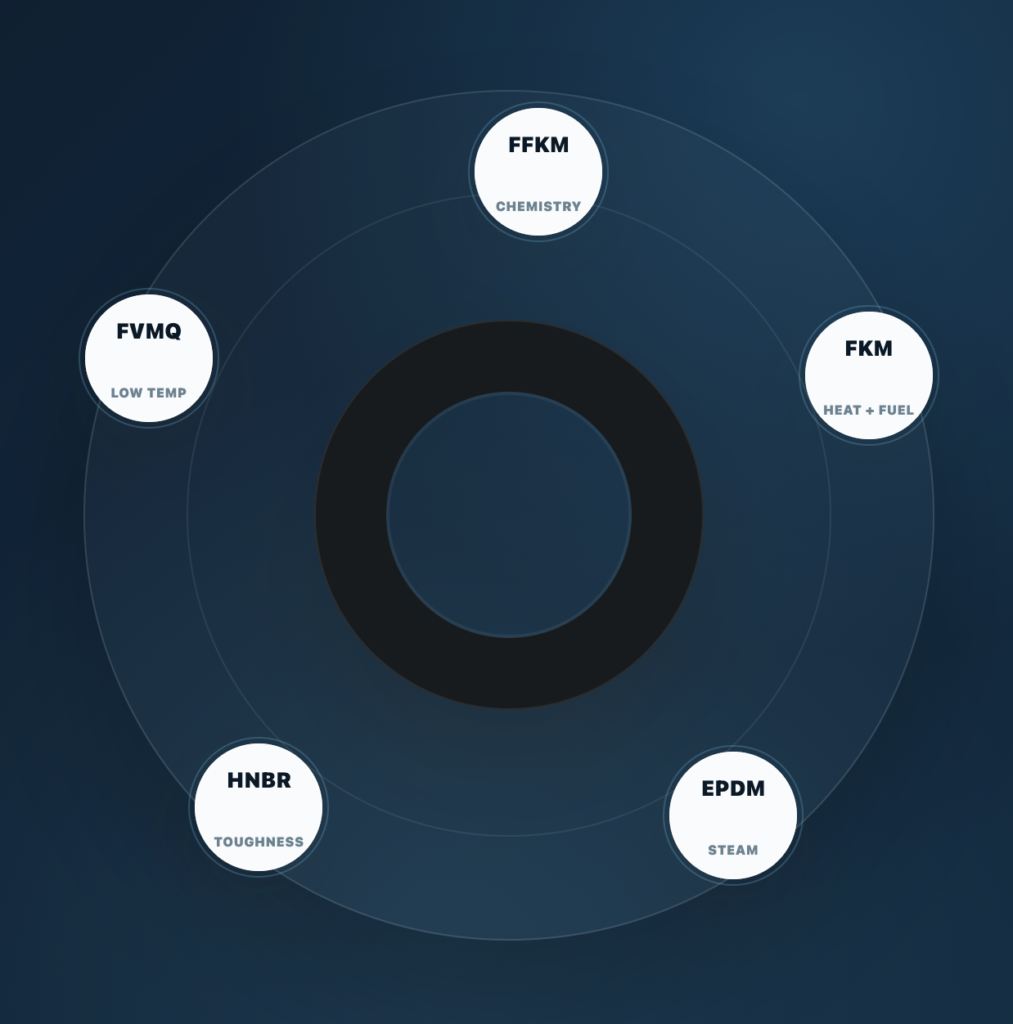
ULTRASWAGE PRODUCT DIVISIONS
One engineering platform. Four specialist areas.
Temperature alone never selects the seal.
Correct polymer selection is a combined decision involving fluid chemistry, continuous and peak temperature, pressure, static/dynamic duty, extrusion gap, decompression, cleanliness, regulatory requirements and expected service life.
Media
What contacts the seal: oil, steam, acid, solvent, fuel, gas, plasma chemistry, food or water?
Temperature
Continuous temperature, peak exposure and cold start can point to entirely different polymers.
Mechanics
Static or dynamic? Pressure, abrasion, extrusion gap, compression set, motion and decompression matter.
Compliance
Food, potable water, semiconductor, medical, aerospace or oil-and-gas qualification may need special grades.
From deep-cold flexibility to 300°C+ chemistry.
Family-level screening ranges only. The actual compound, medium and exposure time determine the safe working envelope.

FVMQ
≈ -70 → +180
VMQ
≈ -55 → +200
EPDM
-45 → +150
HNBR
-30 → +150
FKM
-20 → +200
FEPM
-9 → +232
FFKM
-15 → +325
NBR
-30 → +100
VMQ and FVMQ look related. Their reason for use is very different.
Both retain excellent low-temperature flexibility, but fluorosilicone is chemically modified to handle fuels and hydrocarbon media far better than standard silicone.
VMQ
Choose it for temperature span, cleanliness and flexibility.
≈ −55°C to +200°C
Excellent for clean dry-heat, food/medical, electrical and very-low-temperature applications. Standard VMQ is generally not the first choice for petroleum fuels or aromatic hydrocarbons.
Special grades: Parker notes special silicone compounds can extend toward approximately −115°C on the low side or +260°C on the high side. These are grade-specific limits, not a universal VMQ envelope.
FVMQ
Choose it when low temperature must coexist with fuel or oil.
≈ −70°C to +180°C
Particularly valuable in aerospace, defence and fuel-system sealing because it preserves silicone-like cold flexibility while substantially improving resistance to fuels and hydrocarbon oils.
An O‑ring does not seal because it is round. It seals because a viscoelastic material is deliberately deformed and keeps pushing back.
The polymer is only one part of the sealing system. The real performance comes from the interaction of compound chemistry, cross-link density, squeeze, groove geometry, surface finish, pressure, temperature, media, time and the ability of the seal to recover after deformation.

-
Initial squeeze
The installed cross-section is compressed so the rubber develops contact pressure against the gland surfaces before system pressure is applied. -
Elastic recovery
The cross-linked polymer network tries to recover its original geometry. That restoring force is the foundation of long-term sealing. -
Pressure energisation
Fluid pressure acts on the O-ring and increases contact stress toward the low-pressure side. At excessive pressure and clearance, the same mechanism can drive extrusion. -
Time changes everything
Heat, chemistry and prolonged compression can reduce sealing force through permanent set or stress relaxation—even when the seal still looks dimensionally intact.
“FKM 75” is not a complete material specification.
Two black O-rings with the same hardness and the same polymer abbreviation can behave very differently in the same machine. The finished compound is the result of several independent design choices.
Polymer backbone
NBR, HNBR, EPDM, FKM, FVMQ, FEPM and FFKM each start with a different molecular backbone. That backbone establishes the broad chemical, thermal and low-temperature character.
Monomer / fluorine content
NBR changes with acrylonitrile content; FKM families change with monomer architecture and fluorine content. More chemical resistance can come with a low-temperature trade-off.
Cure system
Peroxide, bisphenol and other cure chemistries influence heat resistance, steam resistance, compression set, cleanliness and chemical performance.
Compliance
Food, potable water, semiconductor, medical, aerospace or oil-and-gas qualification may need special grades.
Hardness & network density
Harder compounds can improve extrusion and handling resistance, but hardness alone does not describe stiffness, recovery, compression set or seal life.
Post-cure & cleanliness
For many FKM, FFKM and silicone systems, controlled post-cure helps complete cross-linking, remove residual volatiles and stabilize final performance.
FKM and FFKM should never be treated as one-line catalogue entries.
The fluorinated elastomer family contains multiple polymer architectures. Understanding these differences is what separates genuine application engineering from simply quoting “Viton” or “FFKM”.
FKM
Different FKM types solve different problems.
≈ −55°C to +200°C
Excellent for clean dry-heat, food/medical, electrical and very-low-temperature applications. Standard VMQ is generally not the first choice for petroleum fuels or aromatic hydrocarbons.
-
A / E type
General-purpose FKM; strong heat, oil and fuel performance; good compression-set behaviour. -
B type
Higher fluorine content; improved fluid resistance, especially more aggressive fuel blends and acids. -
F / GF type
Higher-fluorine FKM for stronger fuel, solvent and aggressive-fluid resistance, usually with a cold-flexibility trade-off. -
GLT type
Engineered primarily for improved low-temperature flexibility versus traditional general-purpose FKM. -
GFLT type
Balances improved low-temperature flexibility with better fuel resistance than GLT-type materials. -
Special ETP / high-chemical FKM
Designed to improve resistance to polar solvents and chemicals beyond conventional FKM, but still not a universal substitute for FFKM.
The exact nomenclature varies by polymer supplier. Ultraswage should identify the actual base polymer and compound code—not sell all fluoroelastomers under one generic label.
FFKM
FFKM is a platform of specialized compounds.
≈ −70°C to +180°C
General chemical
Ultra-high temperature
Amine / steam resistant
Low temperature
Semiconductor / high purity
Oil & gas / decompression
A single “FFKM temperature range” can be misleading. Current supplier portfolios show specialty grades ranging from approximately −46°C low-temperature capability to as high as +350°C heat capability—but these extremes belong to different compound designs.
A seal can fail by swelling, shrinking, softening, hardening—or by chemical destruction of the network.
Compatibility tables are an excellent first filter. They are not final application approval. Fluid concentration, temperature, pressure, time, additives and compound formulation can completely change the result.
Swelling
Fluid is absorbed into the elastomer. Moderate swell can sometimes be tolerated in static service, but excessive swell increases friction, reduces mechanical strength and can overfill the gland.
Shrinkage / extraction
Plasticizers or soluble ingredients can be extracted. The seal may lose volume, contact stress and flexibility after media exposure or after drying out.
Softening
A large hardness drop may indicate fluid absorption or network damage, increasing extrusion and wear risk.
Hardening / embrittlement
Oxidation, chemical attack or thermal ageing can reduce elongation and recovery until the seal cracks instead of flexing.
Network degradation
The chemical attacks the polymer or cross-links themselves. This is fundamentally different from reversible physical swelling and usually signals true incompatibility.
Measure more than volume.
Advanced elastomer compatibility evaluation tracks volume change, hardness change and tensile/elongation retention after controlled exposure. Richter’s laboratory guidance uses tighter volume-change expectations for dynamic sealing than for static sealing because dynamic seals have less tolerance for dimensional and friction changes.
≈ −5% to +25% volume change
≈ −5% to +10% volume change
Low-temperature sealing is about recovery—not just whether rubber has “frozen”.
At low temperature, molecular mobility falls and the seal recovers more slowly. At high temperature, oxidation, cross-link changes and stress relaxation can permanently reduce sealing force. A useful temperature specification therefore needs more than one number.
Cold recovery
TR10 measures the temperature at which a stretched, frozen elastomer recovers 10% after warming. Specialist O-ring laboratories use it as one of the most meaningful conservative indicators for low-temperature sealing behaviour.
Glass transition
Differential scanning calorimetry identifies thermal transitions in the polymer. It is useful for comparing cold behaviour and can also reveal residual cure reactions in some under-cured seals.
Compression set
Compression set measures permanent deformation after a compressed specimen is aged and released. It is a valuable process and material-control test, but it does not directly measure how much sealing force remains in service.
Compression stress relaxation
CSR tracks the actual decay of compressive force over time under temperature and media exposure—closer to the long-term sealing-force question than a simple hardness reading.
Viscoelastic behaviour
Dynamic mechanical analysis measures storage modulus, loss modulus and damping versus temperature/frequency, making visible how an elastomer transitions from flexible to glass-like behaviour.
Shore A and IRHD are related concepts—but they are not interchangeable measurements.
Shore A is extremely useful for standardized compound test slabs. For small finished O-rings, Micro-IRHD is often the more appropriate finished-part method because it uses a much smaller indenter. Geometry, cross-section and support condition can influence the result.
Hardness also should not be treated as a direct substitute for stiffness, compression set, extrusion resistance or cross-link quality. Two compounds at nominal “75 hardness” can still have very different tensile stress, recovery and ageing behaviour.
-
Shore A
Excellent compound control on standard specimens -
IRHD‑M
Preferred route for many small finished O‑rings -
Do not
Use a simple conversion formula between Shore A and IRHD‑M -
Better question
Does the finished compound deliver the intended recovery, tensile behaviour, set resistance and application performance?